
Nikro Air Duct Cleaning in Palo Alto: A Homeowner’s Guide
Nikro air duct cleaning in Palo Alto means using HEPA-filtered negative air machines to capture contaminants as they’re dislodged from ductwork, rather than exhausting them back into your living space. A standard shop vac filters down to maybe 5 microns. Nikro units pull air through HEPA filters rated for 0.3 microns, the size range that includes mold spores, rodent dander, and wildfire smoke particulate. If you’d rather not spend your Saturday researching pressure differentials, call (833) 620-7085 for a straight answer about your Palo Alto home’s ductwork.
What Nikro Equipment Actually Does Inside Your Ducts
Nobody wakes up wondering about negative air pressure. But if you’ve got ducts contaminated with mold-adjacent debris, rodent residue, or post-fire particulate, the difference between a Nikro HEPA unit and a consumer-grade vacuum is the difference between removing the problem and redistributing it.
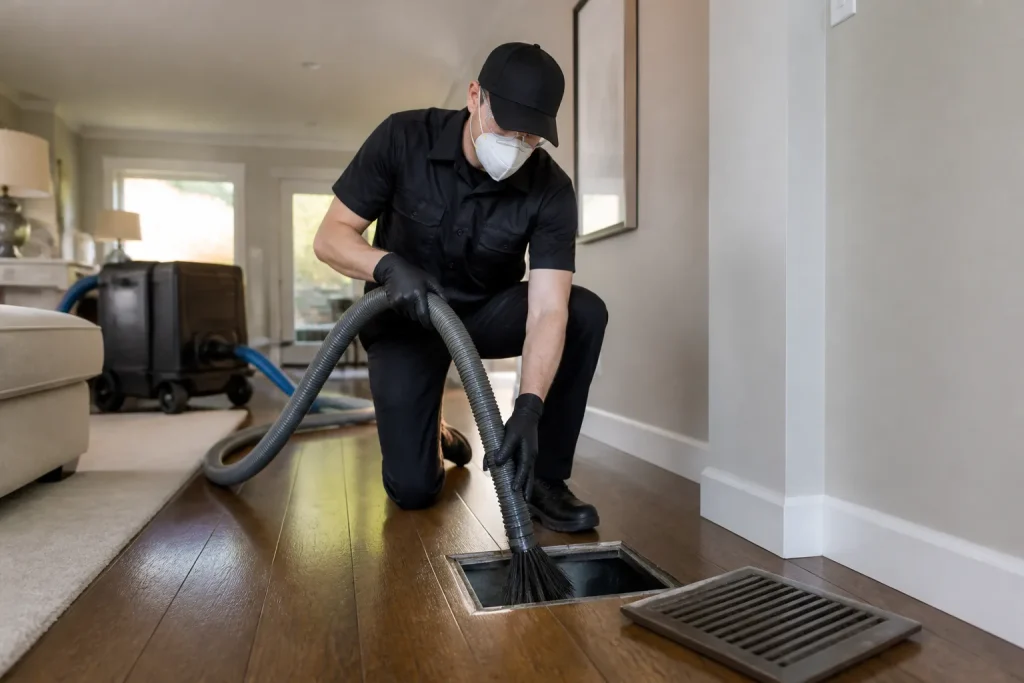
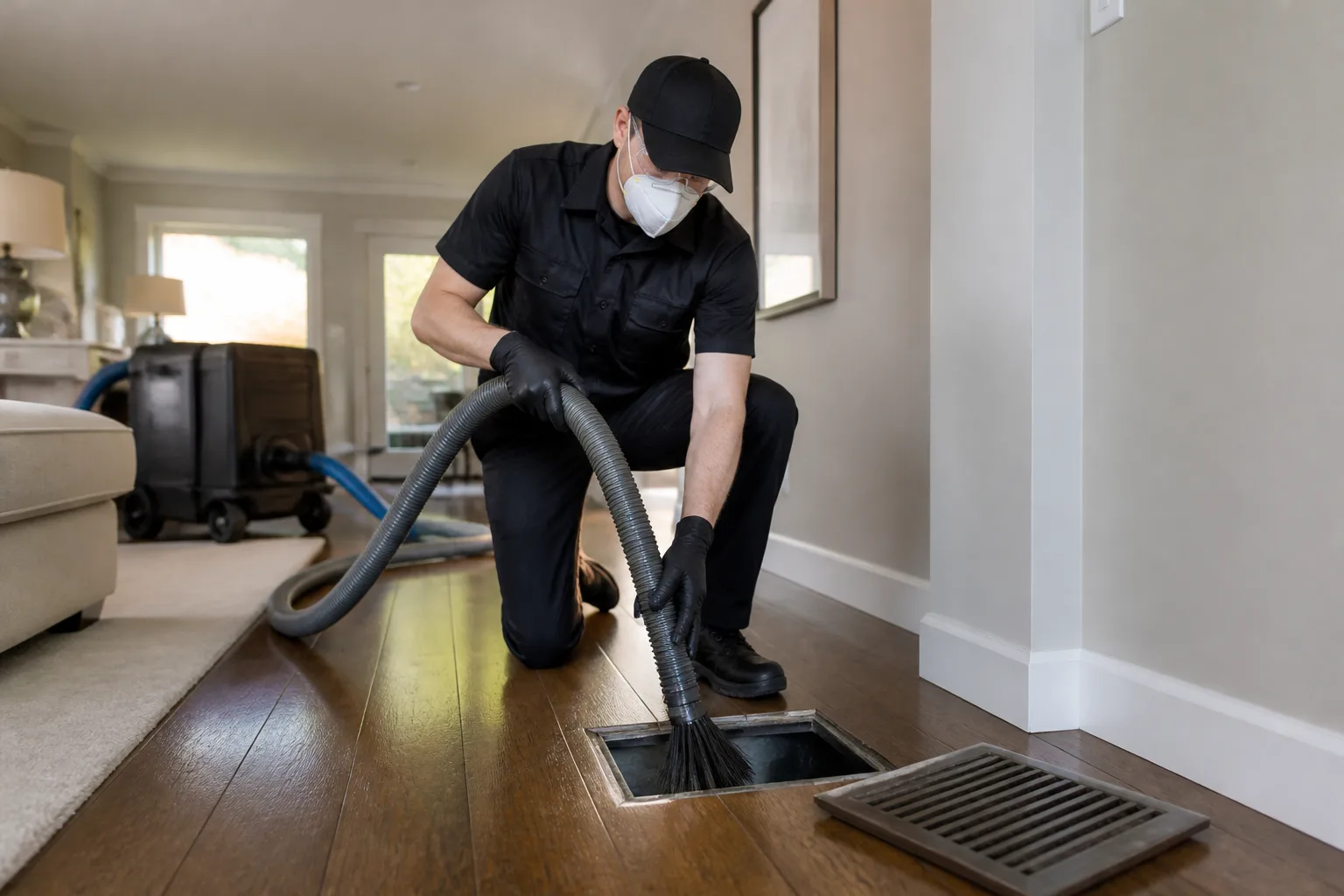
Here’s the plain-language version. A Nikro machine connects to your duct system and continuously pulls air through a HEPA filter before exhausting it outside or into a sealed containment area. This creates negative pressure inside the ductwork. When a technician then runs mechanical agitation tools through the ducts, every particle knocked loose gets drawn toward the Nikro’s collection point, not pushed out through a register into your hallway. A shop vac does the opposite: it picks up what’s directly in front of the nozzle and exhausts the fine stuff right back into the room. The visible dust disappears. The sub-5-micron particulate just moves from your ducts to your air.
That’s the core distinction. And in Palo Alto, where older homes in neighborhoods like Midtown and Crescent Park often have decades-old duct runs with panned joist returns, that distinction carries real weight. A panned return uses wall and floor cavities as return pathways. Those cavities collect dust in ways sealed ductwork doesn’t. Dislodging it under negative pressure keeps it contained. Dislodging it without negative pressure spreads it through the home’s breathing space.
When Nikro-Class Equipment Is the Right Call in Palo Alto
Not every duct cleaning job requires HEPA negative air. A relatively clean system in a newer Palo Alto home might be adequately served by powerful collection combined with thorough brush agitation. But there are specific scenarios we see in this area where Nikro-class equipment is the appropriate standard, not an upsell.
Post-wildfire smoke exposure. Palo Alto sits roughly 15 miles from the wildland-urban interfaces that burned in the 2020 CZU Lightning Complex and sees smoke drift from fires across the broader Bay Area every fire season. Homes that had windows open during heavy smoke events often have combustion particulate settled inside supply ductwork. That particulate sits in the sub-micron range. Removing it without HEPA exhaust filtration just aerosolizes it a second time.
Rodent intrusion. Rats and mice in crawlspaces and attics are a year-round reality in Palo Alto, particularly in neighborhoods with older housing stock like Professorville and Old Palo Alto. When rodents nest near or inside duct runs, the contamination concern isn’t just droppings you can see. It’s the dander, urine residue, and particulates that have gone airborne and settled along the entire duct length. Negative pressure containment lets a technician clean without turning that material into room-level contamination.
Mold-adjacent systems. Nikro machines are manufactured by a company with deep roots in the restoration and abatement industry. That’s a meaningful pedigree. When a Palo Alto home has experienced water intrusion near the HVAC system, whether from a leaky roof over an attic-mounted air handler or moisture in a crawlspace duct run, the cleaning standard should reflect containment, not just contact cleaning. Nikro’s HEPA negative-air approach aligns with how professional remediation is performed.
Rotobrush and Nikro: How the Two Systems Work Together
Nikro equipment doesn’t replace mechanical agitation. It complements it. Think of the Nikro unit as the collection and containment backbone. Think of the Rotobrush system as the tool that physically breaks debris loose from duct walls so the Nikro can capture it.
Here’s how a typical job integrates the two:
- Technicians seal off registers and connect the Nikro HEPA negative-air unit to create continuous vacuum pressure through the duct run
- A Rotobrush cable system with rotating brushes travels through the ductwork, mechanically dislodging compacted dust, hair, construction debris, and the accumulated film of years
- Dislodged material gets pulled toward the Nikro’s collection point by the negative pressure differential, where it’s captured and HEPA-filtered
- The process repeats per duct run until the full system is cleaned
In ducts with significant debris loading, compressed air or specialized agitation tools may supplement the brush work. The Nikro remains the anchor, ensuring that whatever gets knocked loose gets pulled out, not pushed out.
There’s a difference between owning this equipment and renting it job-to-job. A company that owns Nikro and Rotobrush systems has built its workflow around them. Technicians know exactly how the pressure relationships behave in different duct configurations, how long to run each phase, and how to verify containment during the job. A contractor renting a HEPA negative-air unit for a one-off mold-adjacent project is improvising. That distinction shows up in process knowledge, which shows up in outcomes.
What a Nikro Job Looks Like From Start to Finish
If you schedule air duct cleaning in Palo Alto with Nikro-level equipment, here’s what to expect operationally.
First, access points. Technicians need to reach the duct system. That typically means either removing the air handler panel to access the supply plenum, cutting an access hole into the return duct near the unit, or using an existing filter slot when possible. Every access point gets sealed around the equipment to maintain the negative pressure relationship.
During the job, containment is verified by checking that air is flowing into the ducts through registers, not out of them. Technicians use smoke pencils or pressure readings to confirm the Nikro is pulling, not leaking. That’s a real verification step, not window dressing.
After mechanical cleaning, the team does a visual inspection, often with camera or borescope equipment, to confirm debris removal. In Palo Alto homes where we’ve found significant rodent activity, that post-clean inspection matters a lot. It’s how you know the cleaning reached the far end of the longest duct run, not just the first ten feet from the register.
Finally, the Nikro keeps running during the removal and sealing process so any residual airborne particulate gets captured. The last thing to occur is the production of more airborne contaminant. That sequencing is a small detail with a large effect on final air quality.
We pulled a plastic dinosaur out of a return duct in a Midtown Palo Alto home last year. The homeowner’s four-year-old had been dropping toys into floor registers for months. The Nikro caught the half-dozen smaller items that had made their way into the deeper duct runs, including three crayons and what we’re fairly certain used to be a Pez dispenser. Children’s toys in ducts don’t require HEPA filtration, but the fine dust packed around them had been there since the 1990s. That’s what the negative air captured while we fished out the menagerie.
Nikro Versus Standard Duct Cleaning: What to Ask Any Contractor
If you’re comparing Air Duct Cleaning Palo Alto home service providers, the Nikro question is worth asking directly. Not because the brand name is magic, but because the answer tells you what class of equipment you’re paying for.
Ask these three questions:
- “What kind of filtration does your vacuum system use?” If the answer is “HEPA” and they can name the unit, you’re talking to someone running professional containment. If the answer is vague or heavy on the word “powerful,” you’re probably looking at a truck-mounted or portable unit with basic filtration.
- “Do you own your negative-air equipment or rent it?” Ownership implies recurring use, which implies process familiarity. Rental implies this is an uncommon scenario for that contractor.
- “How do you verify containment during the job?” A technician who runs Nikro-class equipment should be able to describe pressure checks, smoke tests, or airflow verification. If they look confused, they may have the machine but not the method.
Equipment matters. But it matters because of what it lets a technician control, not because the machine does the work by itself. Nikro HEPA negative-air systems give the technician a containment envelope. Within that envelope, the quality of mechanical agitation determines the quality of the clean. The two factors work together.
This is also where the full-scope angle comes in. A contractor that runs air duct repair in Palo Alto as a standalone service can address damaged ductwork found during cleaning, rather than cleaning around a problem and walking away. Disconnected duct runs, crushed flex sections, and unsealed joints are common finds in older Palo Alto homes. Cleaning without repairing them means the system pulls attic or crawlspace air right back into the airstream.
Filtration Integration: Cleaning Is One Part of the Air Quality Picture
Nikro equipment addresses what’s already lodged in your ductwork. But a full air-quality picture in a Palo Alto home includes what’s entering the system moving forward. We install and service Honeywell and Aprilaire filtration products as part of that picture. A properly sized media filter cabinet catches particulate before it reaches the evaporator coil and duct walls. That’s not a replacement for cleaning; it’s a complement that extends the value of the cleaning.
The same logic applies to dryer vent service. A clogged dryer vent loads your laundry room air with lint particulate every time the dryer runs. We treat dryer vent cleaning in Palo Alto as a fire-prevention service first, because the data is unambiguous: clothes dryer fires account for thousands of residential fires annually, and the majority trace back to accumulated lint in the vent run. But the secondary benefit is air quality. Lint is particulate. A vent that’s pushing lint into the wall or living space is an avoidable contaminant source.
When to Call a Pro
If you’ve read this far, you may be wondering whether your ducts need Nikro-level cleaning or something more standard. Here’s a practical decision framework:
- You’ve had wildfire smoke exposure with windows open during a heavy event: Nikro-class HEPA negative-air cleaning is the appropriate standard
- You’ve seen rodent sign in your crawlspace, attic, or near duct registers: HEPA containment is warranted
- You’ve had water intrusion or visible mold near HVAC components: containment matters, and you should also address the moisture source
- Your home is newer and the system is relatively clean: a thorough mechanical cleaning with good collection may be sufficient, but HEPA filtration is never a downside
Anyone claiming a single universal answer to “what does my duct system need” without looking at it is guessing. A real assessment requires access to the system, ideally with camera inspection.
The Bottom Line
Nikro equipment represents a specific class of technology: HEPA negative-air machines designed for contamination containment. In Palo Alto, where older housing stock, wildfire smoke exposure, and rodent pressure are all real factors, that containment capability translates directly to what ends up in your breathing air after a cleaning job versus what stays trapped in the ducts and recirculates for years. The Rotobrush Nikro combination, where mechanical agitation meets HEPA collection, is the workflow we’ve built our cleaning process around. If you’re weighing contractor options, asking about filtration class, equipment ownership, and containment verification will tell you more than any certification badge. If you’re in Palo Alto and want a straight assessment of what’s inside your ductwork, call (833) 620-7085 for a free estimate. We’ll bring the camera, show you what we find, and if your ducts are in decent shape, we’ll tell you that too.
Frequently Asked Questions
Nikro air duct cleaning uses HEPA-filtered negative air machines to create continuous vacuum pressure inside ductwork during cleaning, capturing contaminants as they’re dislodged rather than exhausting them into the living space.
No. For relatively clean systems in newer homes, standard collection with good mechanical agitation may be adequate. Nikro-level HEPA containment becomes the appropriate standard when dealing with wildfire smoke particulate, rodent contamination, or mold-adjacent duct conditions.
Ask directly whether they own HEPA negative-air equipment and what their containment verification process looks like. A contractor running Nikro-class systems should be able to describe pressure checks or smoke testing. Vague answers to these questions are a red flag.
Rotobrush systems provide mechanical agitation: rotating brushes that dislodge compacted debris from duct walls. Nikro machines provide HEPA-filtered negative air collection. A complete cleaning uses both: Rotobrush knocks material loose, Nikro captures it under containment.
Written by the team at Air Duct Cleaning Palo Alto, serving Palo Alto since 2016.
Need Air Duct Cleaning Help?
Call Air Duct Cleaning Palo Alto - licensed & insured, here with fast help in Palo Alto.
(833) 620-7085